Have you got the home improvement bug? I thought so! Well, you’re not alone – since 2020 we’ve seen a massive boom in the flooring market, and this includes artificial hard floorings such as LVT (luxury vinyl tile) and laminate. But how does LVT vs laminate compare?
Don’t worry we’re not going to leave you hanging: read on to discover which of these popular flooring options are right for your project and right for your home.
What is LVT (luxury vinyl tile) flooring?
It seems that everyone throws around the term LVT, but how many know what it’s actually made of or how it’s manufactured?
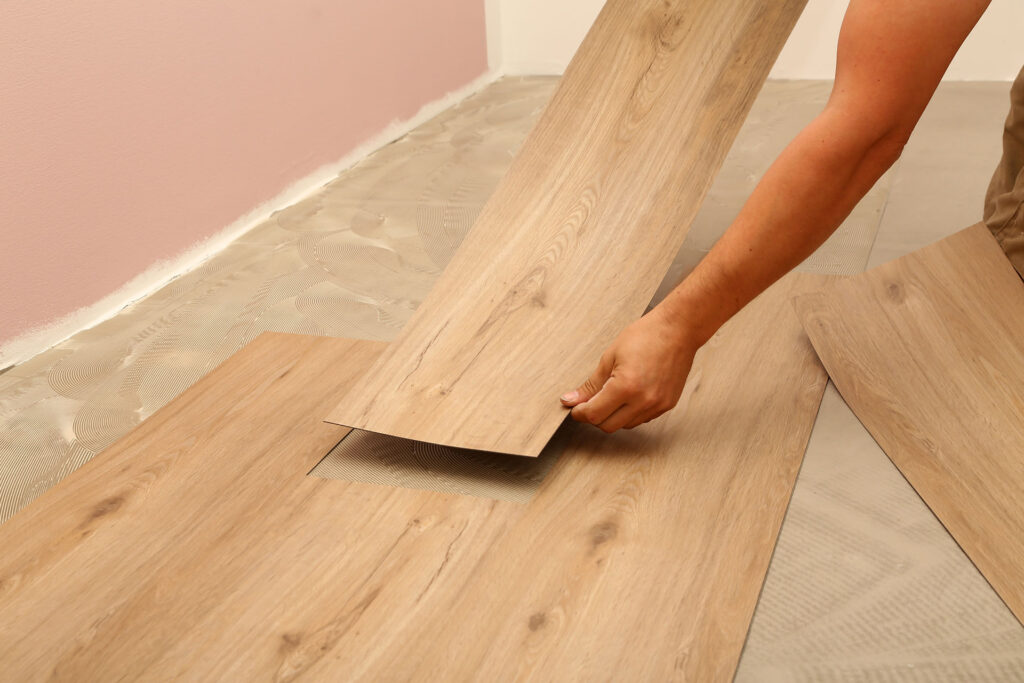
Simply put, LVT is a type of flooring made from PVC-based materials that are manufactured in planks or “tiles”. Thanks to their plastic core, as well as being incredibly durable, they can be flexible too.
You might also run into SPC (stone plastic composite) vinyl, which is similar, apart from the fact that it benefits from a more rigid core, offering higher levels of durability and greater design possibilities.

What is laminate flooring?
Now, what is laminate flooring made of? I’m glad you asked. Laminate flooring is well-known as the prototypical alternative to wooden floors and is comprised of durable high-density fibre boards.
These fibre boards are manufactured from layers upon layers of compressed wood pulp coated in an exterior layer of hard-wearing plastic, making them both strong and relatively low cost.
LVT vs laminate flooring: what are the key differences?
At a glance, you might not see an immediate difference between LVT and laminate floors, but there are a number of features you need to consider before you decide which material is right for you.
To make things as easy as possible, we’ve put these factors into a handy table.
The differences between LVT vs laminate
| Attributes | LVT (luxury vinyl tile) | Laminate |
| Material | PVC planks | High density fibre boards |
| Thickness | 2 – 8mm | 6 – 12mm |
| Durability | Generally, more hard-wearing scratch and stain-resistant due to its thickness and flex | Reasonably durable and scratch resistant |
| Waterproofing | 100% water-resistant | Poorly installed / lower quality laminate is vulnerable to water damage and warping |
| Heat resistance | Compatible with underfloor heating – up to 27 degrees | Compatible with underfloor heating – up to 27 degrees |
| Lifespan | Up to 25 years | 15 –25 years |
| Maintenance | Easy clean, can be scrubbed more vigorously | Easy clean, generally more stain resistant |
| Aesthetics | Greater variety of design options from hardwood-look to marble and patterned tile effect | Good variety of appearances and colour, but often with greater surface depth to mimic hardwood floors to a higher level |
| Comfort and sound | Less natural feel, but can be improved with high quality underlay | More natural feel, can also be improved by investing in a good underlay |
| Installation | Loose lay / floating installation and sometimes glued down | Loose lay / floating installation |
| Price | £20 – 45 per square meter | £18 –31 per square meter |
| Warranty | 15 years + | Up to 15 years |
LVT vs laminate price comparison
As costs carry a lot of weight in the overall decision process, let’s dig a little deeper.
Basic LVT or high-end luxury vinyl tile
One important factor when it comes to costs is whether you decide to go for a more high-end LVT option. On average, you’ll see LVT flooring prices range between £20-24 per square meter, but prices will increase if you choose a more unique pattern such as herringbone or a higher quality and more realistic finish.
Cost-efficiency
Next up in our considerations is the flooring’s overall cost efficiency. It’s all well and good opting for a cheaper product under the assumption it will save you money, but if it’s not suited for your specific project you might end up spending more in the long run.
If it’s a high-traffic area or room where pets will be allowed, it’s worth considering the most durable option. And conversely, if you’re decking out a room that will be scarcely used in comparison to the rest of your home you might feel inclined to choose an option with a thinner wear layer.
DIY or professional installation.
Another way to reduce your overall price tag is to consider doing the job yourself. It’s relatively easy to learn how to lay underlay or install a laminate or LVT floor. All it takes are the right tools and a competent DIYer.
If you feel uncertain or unable to, it’s probably best to leave it to a professional – you can still shave a little off the price here by opting for a local independent flooring fitter.
Which is better: LVT or laminate?
Finally, we arrived at the question you’ve been dying to ask: is LVT better than laminate? Or does laminate come out on top?
The short answer is that it depends on your individual project and budget.
Why choose LVT flooring
If you can afford to splash out on the pricier option (LVT), then this is a brilliant way to accident-proof your floor and achieve a striking effect – useful if you have young children, pets or furniture you will be moving about the room.
Compared with laminate, LVT is far more water resistant, making it far more suited to kitchens, bathrooms and utility rooms, and especially as you factor in how you can put in more elbow grease to scrub its surface.
Why choose laminate flooring
If your priority is a natural feel underfoot and – perhaps more importantly – to save a little, you might want to choose laminate flooring. While slightly less hard-wearing, it gets the job done, offering a greater range and depth of designs due to its thicker structure.
The gist of it
So to recap, when it comes to LVT vs laminate, LVT is generally more expensive due to its more hardwearing properties and longer lifespan, ideal for high-traffic rooms. However, if you’re looking for a more realistic impersonation of hardwood, laminate is the way to go.
This being said, your biggest takeaway should be that flooring is always a personal choice. So if you take a fancy to a specific design some of these considerations might float into the ether!