It’s all over home improvement content on social media, in interior design magazines, and on the lips of your friends and family who’ve fallen into the DIY rabbit hole: engineered wood. In fact, if you spend any time in homeowning circles, you’ll quickly find that families, landlords and couples are obsessed with it. I’m not surprised; it’s one of the most robust materials I work with as one half of the Derwenthorpe Flooring duo.
But… I’m getting ahead of myself. Let’s circle back to the all-important question: what is engineered wood flooring? And is it really worth all the praise?
Answers to all that and more coming up.
Skip to:
- What is Engineered Wood Flooring?
- A Micro History of Engineered Wood Flooring
- Its Defining Characteristics
- Home/Lifestyle Compatibility
- The Installation Process
- Some Examples in Real-Life Homes
- Conclusion: So, What’s the Verdict?
What is Engineered Wood Flooring?
We’ve all heard about wooden flooring. It predates pretty much any other construction material, emerging alongside the technology of floorboards itself. Stick “engineered” in front of it, and that’s when I see the question marks crop up.
Fortunately, it’s very easy to grasp: engineered wood flooring is comprised of reconstituted wood, treated for better all-round performance. You have thin layers of timber adhered together to form a sturdy plank around a central core. The surface ‘wear’ layer is an aesthetic veneer, usually an oak, beech, maple or birch to show off a distinctive grain pattern, while the backing brings increased strength and durability.
This structure provides great stability and flexibility, making the material more amenable to heat than solid wood. Yes, it’s underfloor-heating compatible! And because it’s made from thinner layers of ply, the price tag is way more affordable than its traditional counterpart.
Of all the different kinds of flooring, it’s favoured for its versatility, suited to a range of subfloors and rooms – but more on that later. First, here’s a tiny glimpse into its development.
A Micro History of Engineered Wood Flooring
Engineered wood came about as a flooring solution to tackle the cost of traditional floors, which were more difficult to install. Developed as one of the first materials you could lay swiftly and effectively over concrete subfloors, it’s easy to see why it took off.
Nonetheless, it wasn’t until the 60s that engineered wood flooring properly penetrated the market for homeowners, and back then, its composition wasn’t how we know it today.
In the early phases, engineered wood was considered a replacement for hardwood planks, rather than an alternative in its own right. Therefore, the earliest iterations were… janky to say the least. The bottom layers, plywood sheets, were completely random lengths and widths, leading to warping and weakness, which contributed to the material’s temporary decline in popularity.
The good news, though, is that in the year of our lord 2026, these issues are well and truly consigned to the past. Manufacturers have come a long way, and it shows: the global engineered wood flooring market is booming, with warm oak trending in UK homes from York to Brighton.
Its Defining Characteristics
While I’m primarily a flooring installation pro, I’m also a personal fan of engineered wood, having fitted it under my own roof. In my book, it’s truly the best of the best. Practical yet stylish, guaranteed to add value to your home, a breeze to maintain, and something you’ll never have to replace if you treat it well, the list of merits goes on.
Pros: Pick Engineered Wood Floors IF…
- You want a high-impact aesthetic and love that timeless, natural appeal
- You’re after a wealth of wood flooring design options, from herringbone to chevron and beyond
- You’re refurbing a high-traffic area prone to lots of footfall and pattering paws
- You need something extra strong and impact-resistant
- You’re keen for something more repair-friendly than, say, LVT or laminate (scratches are a straightforward fix with a touch of resanding and refinishing)
- You’re kitting out a bathroom or kitchen and, therefore, need top-notch dimensional stability and water resistance
- Low maintenance – just – floats your boat
- You’re after a DIY-friendly floor, you can fit without too much trouble
- You’re happy to invest in a flooring cover at a mid to high price point
Cons: Avoid Engineered Wood Floors IF…
- You’re looking for a budget option – with engineered wood, buying cheap usually means buying twice
- You want something 100% watertight for a wet room, for example
- You want a quirkier, more unique aesthetic
- The biophilic look is a turnoff
PS: If you want the complete lowdown on the cost of engineered wood, check out our buyer’s guide.
Home/Lifestyle Compatibility
Looking at the specs above, the reason why engineered wood is a clear winner for many households has got to be its versatility. A snug fit across a range of properties, old and new, it handles underfloor heating amazingly, makes a sophisticated addition to your living room, and can be installed on top of timber and concrete subfloors alike.
Best of all, it’s robust enough to handle even the most chaotic family homes, holding up well against moisture, spills, knocks and scratching. By the same token, engineered wood is a suitable choice for stairs, allowing you to achieve a seamless flow between rooms if you’re looking to deck out an entire corridor or floor in the same material.
The only real downside, as I mentioned, is the price tag. But, squared against the value it brings to your property and the 30+ years of stunning use, it pays for itself in the long run.
The Installation Process
Sure, I’m a little biased, but with engineered wood, I usually signpost folk towards the professional fitting route. After all, that’s how you get the best fit.
However, if you’re set on DIYing it, you can still achieve a lovely finish – as long as you follow the best practice steps very carefully.
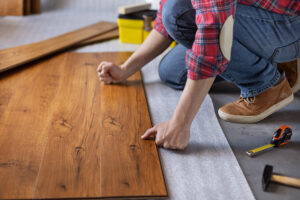
On the whole, it’s fairly beginner-friendly: the majority of engineered wood is ‘floated’ by clicking tongue-and-groove boards together, which I’d recommend for newbies, but planks can also be nailed or glued down. Do note that complex patterns – think parquet – are best left to the specialists (like me and Anthony!).
Some Examples in Real-Life Homes
I’ve probably sold you on the beauty and convenience of engineered wood, but don’t just take my word for it. Here are a few examples in real-life homes, including a few that we fitted.
This was a fun job! It followed on from some previous work we completed a couple of years prior. The customer was chuffed with the end result: an eye-catching herringbone providing a needed bit of visual texture and pizazz.
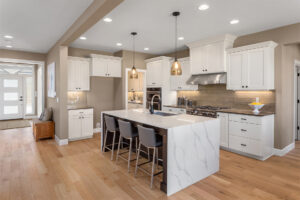
Speaking of pizazz, how’s this? In large, open plan spaces, pattern-rich engineered oak really grounds the space and helps your décor work even harder.
Sometimes, simple is enough. And here our customer certainly agreed. This light, engineered oak uplifted the living space just beautifully.
Proof that even dark, rich shades look gorgeous in the modern home. If you’re after something with a life of its own to deepen the character of your interiors, something like this aged oak works a treat.
Conclusion: So, What’s the Verdict?
There is no doubt in my mind that if you like your flooring au naturelle, you’ll fall head over heels for engineered wood. You may have to shell out a tad more money than budget options like vinyl or lino, but then you’d be missing out on premium stability, endurance, water resistance and those unbeatable, timeless looks.
What’s next? Take a look at the top brands to create a shortlist of your dream floor, then get ready to pencil in a date for the big transformation. Actually, I can help you with that last one. Give me, Chris, a call to book in your engineered wood installation for an award-winning fit by installers who obsess over the details. Jobs a good’un.