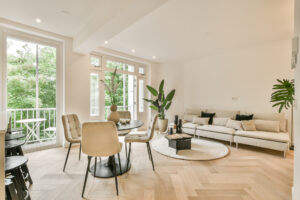
Are you a cat or dog person? Do you prefer sweet or savoury? Are you a night owl or an early riser? Wood floors versus carpet, which is best?
Some questions have no expiration date, remaining relevant until the end of time. The latter – the classic “should-I-opt-for-the-comfort-of-carpet-or-the-practicality-of-wood-flooring” debate – crops up for me constantly as a trusted local flooring fitter.
So, I thought I’d create this guide. Consider it a compendium of sorts, chock-full of the advice I’ve imparted to homeowners, landlords and small businesses over the years. Then, I’ll give you my final, specialist verdict – the conclusion I land on might surprise you…
Skip to:
- Why Flooring Choice is a Big Deal
- Wood vs Carpet Table Overview
- A Deep Side-by-Side Comparison
- The Final Verdict?
- Conclusion: Get Ordering Those Samples
Why Flooring Choice is a Bigger Deal Than Most Realise
The first thing you need to understand is that flooring is more than an aesthetic concern.
Yes, it does transform how you feel and relate to a given interior, but it also dictates how much routine maintenance is needed, your overall renovation budget, the comfort levels that its inhabitants experience, and your property’s resale value on top of that.
Not to forget that some materials simply don’t work in certain settings (unless you want to ruin them), for example, carpet and bathrooms never marry well. In other words, are a match made in hell… but I digress.
Collectively, this makes your choice a big deal. So, don’t rush the decision and give the common mistakes a wide berth; then, the flooring regret can’t get you.
Wood vs Carpet in the Blink of an Eye: Your Table Overview
With that quick disclaimer accounted for, we can mosey on to the main event. If you want the short version, here are the must-know specs of wood (solid and engineered) and carpeted floors.
| Carpet | Engineered Wood | Solid Hardwood | |
| Design Variety | Generally brings a pared-down look, but patterned, statement runners and weaves exist. | Brings a classic, timeless appeal, which you can give a ‘bite’ with modern, dynamic patterns. | A more traditional aesthetic, but nonetheless timeless and full of heritage character. |
| Durability and Day-to-Day Performance | Relatively strong, cushions impact and feels luxurious underfoot, but prone to trapped odours, stains, allergens and general wear and tear. Unfit for moist areas. | Water-resistant, stable, shock and scratch resistant as well as high-traffic suitable. | Vulnerable to warping under heat and moisture fluctuation and less structurally sound than engineered wood but exceptionally durable and strong. |
| Price Point | £, even at solid quality. | ££-£££, depending if standard or designer. | £££ new, or £ if restoring an existing floor. |
| Installation | Cheap for a professional to fit, but not DIY-friendly. | More expensive for a professional installation, but a reasonable beginner DIY project. | Pricey professional installation and not worth fitting from scratch. |
| Maintenance | More laboursome: routine hoovering and wiping up spills and the occasional deep clean. Stain prone and generally unrepairable. | Easy breezy maintenance with a hoover, brush, damp cloth or a mop. Damaged boards can be replaced. | Upkeep takes more care as the flooring can’t get very wet. Boards may be refinished. |
| Longevity | Requires replacing every 10 years. | Up to a 30-year lifespan. | 50-100 years, so it lasts a lifetime. |
| Resale Value | No impact unless newly fitted. | Strong resale ROI. | Adds potent real estate value if in top condition. |
| Underfloor Heating Compatibility | Most carpets are compatible, if less than 2.5 TOG. | A natural choice for underfloor heating systems. | Not suitable. |
| Recommended Brands | Cormar, Lifestyle, Manx Tomkinson. | Timba Floors, Brooks. | Ted Todd, Kährs, Russwood. |
Comparing Our Contenders Side-By-Side
Willing to stick around? Great! Allow me to walk you through the differences of these contrasting kinds of flooring from a flooring specialist’s perspective.

First, Though, What’s the Difference Between Real Wood and Engineered Wood?
We can’t continue until I’ve put this common misconception to rest: engineered wood is just wood, right? Well, not exactly…
As I explained in our dedicated introduction to engineered wood flooring, it’s different from solid wood in the sense that it’s reconstituted timber. Built around a sturdy central core, its unique combination of strength and flexibility comes from amassed layers of thin ply. The visible surface is an aesthetic veneer, treated to be highly water-resistant.
This is why it has swiftly overtaken real solid wood in popularity. The real deal, whilst incomparably charming, just isn’t as structurally sound and can’t cope with moisture and heat very well. Then there’s the outsized price tag…
For this reason, I’m going to zero in on engineered wood. So, without further ado, it’s time for our competitors to enter the ring.
First, Let’s Compare Cost
Because, to be completely honest, it’s the biggest factor shaping your decision. A high price tag acts as a gatekeeper to luxury brands and top quality, however, sometimes you’ll see companies inflate the cost for no good reason.
To me, the real question is this: how much are you willing to spend generally, forgetting the materials for a second?
For your engineered wood to be of decent quality, you need to be willing to spend good money on it, yet with carpet it’s much easier to get your hands on better quality at a cheaper price point.
So if you’re looking for something affordable and don’t care for long-term performance quite so much carpet might be your winner. Factoring in longevity and its ability to ward off wear and tear, engineered wood is the most cost-effective choice on a longer timeframe.
- Engineered wood: On average, £35 per square meter for materials, plus £22.50 per square meter for installation
- Carpet: An average material cost of £28 per square meter and then £150- £250 per day for professional installation according to typical UK room sizes.
Whichhhh Brings Us to Installation Differences
Of course, as vastly different flooring types, the pair requires very different installation methods.
First, engineered wood flooring. The process here is relatively straightforward: you acclimatise the boards by leaving them in the installation destination for a couple of days and lay them using the “floating floor” technique. Essentially, you click the tongue and grooves of the boards together over a decent underlay, cut the edge boards to size and leave proper expansion gaps for the material to expand and contract – job’s a good’un.
Yes, that makes it incredibly DIY-appropriate, for beginners and intermediate level handyfolks alike. Do be wary, though, that the specialist route ensures the highest quality finish, especially in the case of complex patterns like parquet – you really don’t want to be doing that on your own.
What about carpet? Well, the short story is that some jobs just aren’t DIYable; this is one of them. Here, the carpet fitter has to measure the room and cut the underlay to size, install track strips along the edges of the room and mould the piece of carpet to the architectural quirks of the room with careful stretching and trimming.
It took me many years to reach award-winning standard. Trust me, it’s not worth attempting as a novice.
Appearance & Texture
Really? This is a matter of personal taste.
Some people prefer a soft, cushioning feel the moment they step out of bed, others are happy to mimic carpet with a handful of strategically placed rugs. In a holiday home, for instance, it’s a good idea to lean into the sumptuous with thick, plush carpets wherever you can sensibly get them. You may have to yield to something more commercially minded – like traditional carpet tiles – in corridors to hush late night footsteps.
However engineered wood is equally having its moment in hospitality settings, namely as a grand entrance to receptions, in dining rooms and lobbies. As one of my favourite solid wood alternatives, I personally love the sheer variety of designs.
You can elevate your home to editorial with sleek diagonal designs or stick to something grounded and comforting yet no less graceful such as wide, luxurious oak planks. In fact, if you’re really creative, you can use the laying pattern to your advantage, moulding visitor’s perception of the space by visually lengthening the room.
Lifestyle and Home Compatibility
Perhaps the most important element after the price tag is how you will ‘get on’ with your new flooring in situ. As much as we can imagine how beautiful it will look in our homes, if it isn’t compatible with the room or your lifestyle, it’s just that: incompatible.
Looking at my overview of specs, it’s understandable why the popularity of engineered wood is on the rise and why it feels like I’m constantly fitting it. Complementing all sorts of properties, 5 to 100+ years old, it’s one of the best candidates for underfloor heating, bathrooms, kitchens and rooms where your pets reside. The only project-impeding downside is that it’s not 100% waterproof, so it won’t work in a wet room. Neither is it quite as convincing as LVT when mimicking real wood.
Carpet, obviously, is hampered in how you can use it. Nowadays, the synthetic fibres it’s made of are much more resistant to water damage than they’ve ever been, but at the same time, you can’t put them in places prone to moisture. Likewise, it’s not the ideal choice for pet owners or those with allergies as the fibres tend to suck in dust and odours.
On the upside, however, they’re a great heat and noise insulation measure that keeps your home much cosier. When this is your sanctuary, it’s difficult to put a price on it.

So, What’s the Verdict?
Curious what came out on top? Let’s unpack the findings.
Renovators should pick carpet IF:
- Comfort and cosiness are an absolute deal-breaker
- They want a highly insulating flooring option
- The aim is to muffle echoey sounds
- They’re after a good quality flooring option at an affordable price point
- Pets aren’t in the equation
- Its home is in a room well away from entry points and moisture
- They’re happy for a specialist to come in and fit it
And, they should opt for engineered wood floors WHEN:
- They prize a high-impact, aesthetically pleasing floor that turns heads
- It’s to match a hectic family lifestyle, in other words, low maintenance is essential
- Draughts and a hard surface don’t bother them (or plans for underfloor heating are in the works)
- The priority is durability: water, scratch, impact and stain resistance are their number ones
- They’re willing to make a higher upfront investment to cash in on greater longevity
- The wooden floor will live in a busier, more traffic-prone living area…
- …Or spaces that experience consistent moisture or outdoor shoes
- They’re after something DIYable for a beginner
And that means…?
*Ding Ding* We Have a Winner!
Wood flooring for the practical, future-thinking homeowner and carpet for those of us who love our creature comforts.
However… I’ve been keeping something under wraps. There’s actually a secret third option on the table: bridging the divide between wall-to-wall carpet or a house entirely clad in wood, we have a compromise on the two.
Increasingly my clients are relegating carpet to upstairs, picking the larger bedrooms to dress up with luxurious wool to save a little cash and then going all out on the higher-traffic zones. An open plan kitchen, naturally, makes an incredible underfoot canvas when decked out in a distinctive chevron or herringbone. Talk about impressing guests!
Then there’s the classic carpet runner x wooden stair tread combo, which I’ve been seeing more and more in York’s Victorian terraces. Here you really can have your cake and eat it (just make sure not to get crumbs on the carpet).
Decided? You Better Get Ordering Those Samples
As the debate trundles on in homes up and down the UK, you can sit smugly knowing exactly which option is right for you.
Plush, cushioning carpet between your toes or the timeless, lived-in quality of textured wood flooring; whichever resonates most with your design sensibilities and, moreover, falls in step with the practical needs of your lifestyle, make sure to get your hands on plenty of samples.
This way, you can weigh up which looks best in situ and see how their colours shift under your interior’s natural light.
Still simmering with questions? Then why not reach out to me and Anthony at Derwenthorpe Flooring; with 40+ years of experience between us, we’ve seen just about everything, so we know how to help. Let’s chat wood floors and carpet today.